



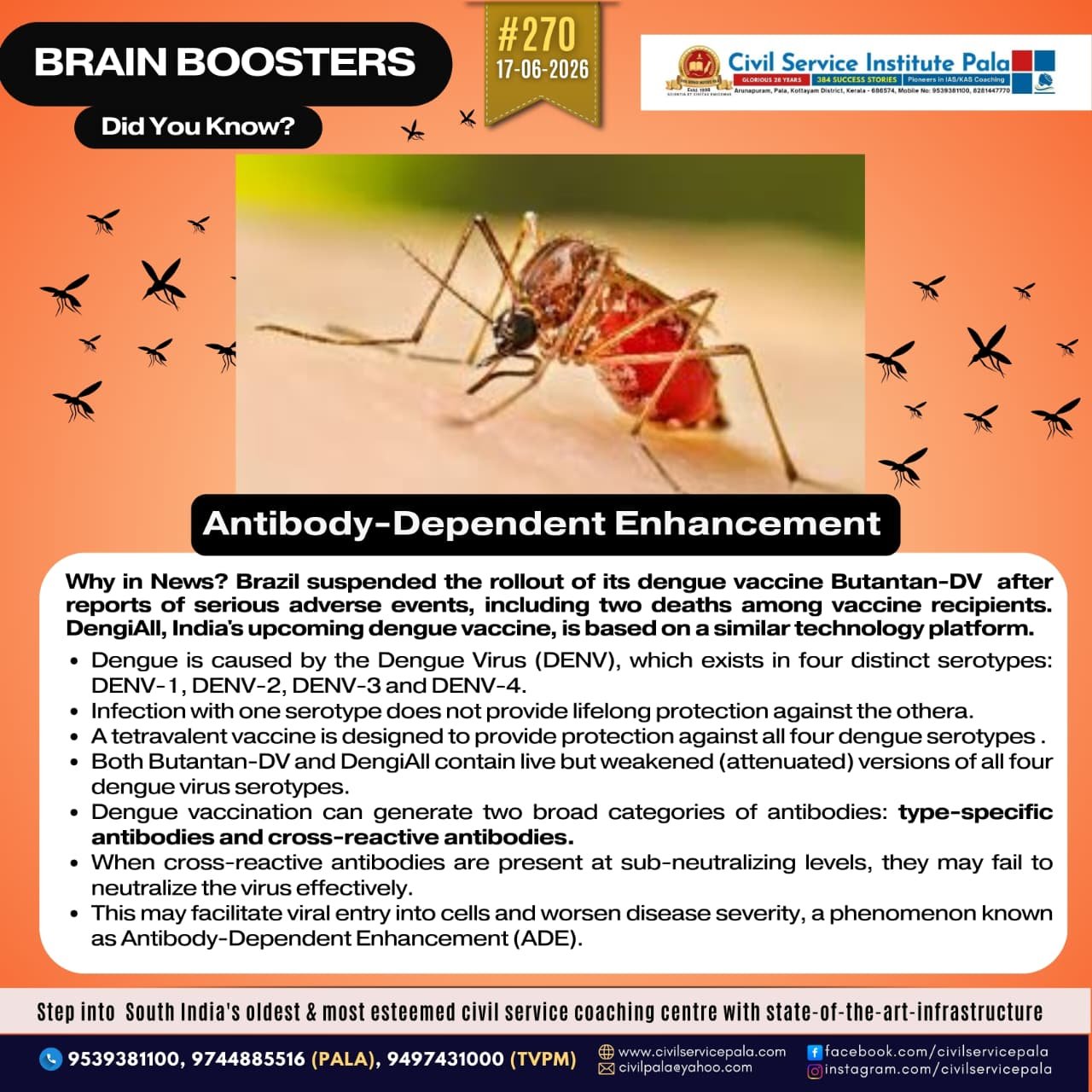
Antibody-Dependent Enhancement (ADE)
Dengue Vaccines, Antibody-Dependent Enhancement (ADE) and India's DengiAll
Why in News?
• Brazil suspended the rollout of its dengue vaccine Butantan-DV on 8 June 2026 after reports of serious adverse events, including two deaths among vaccine recipients.
• The development has attracted attention in India because DengiAll, India's upcoming dengue vaccine, is based on a very similar technology platform.
• In this situation, experts highlight the need for careful evaluation of vaccine safety, particularly the risk of Antibody-Dependent Enhancement (ADE), before large-scale deployment.
Understanding Dengue and Dengue Serotypes
• Dengue is caused by the Dengue Virus (DENV), which exists in four distinct serotypes: DENV-1, DENV-2, DENV-3 and DENV-4.
• All four serotypes are known to circulate in both India and Brazil.
• Each serotype possesses unique envelope (E) proteins on its surface, requiring immunity against all four serotypes for broad protection.
• Infection with one serotype does not provide complete lifelong protection against the other serotypes.
What is a Tetravalent Dengue Vaccine?
• A tetravalent vaccine is designed to provide protection against all four dengue serotypes simultaneously.
• Both Butantan-DV and DengiAll contain live but weakened (attenuated) versions of all four dengue virus serotypes.
• Scientists first developed weakened versions of each serotype separately and later combined them into a single tetravalent formulation.
Antibody-Dependent Enhancement (ADE): The Core Concern
• Dengue vaccination can generate two broad categories of antibodies: type-specific antibodies and cross-reactive antibodies.
• Type-specific antibodies strongly neutralize only one dengue serotype.
• Cross-reactive antibodies can initially recognize multiple serotypes and provide broader protection.
• However, when cross-reactive antibody levels decline, they may fail to neutralize the virus effectively.
• Under such circumstances, these antibodies can facilitate viral entry into cells and worsen disease severity, a phenomenon known as Antibody-Dependent Enhancement (ADE).
• ADE can lead to severe dengue manifestations, including bleeding, shock, and potentially death.
Lessons from Brazil's Butantan-DV Experience
• Reports from Brazil recorded 42 serious adverse events among vaccine recipients, including two deaths and one intensive-care admission.
• Some affected individuals exhibited symptoms resembling severe dengue, such as abdominal pain, persistent vomiting, and bleeding.
• These adverse effects were not reported during Phase-III clinical trials.
• Experts suggest that further investigation is required to determine whether ADE contributed to these outcomes.
• The incident highlights the importance of long-term post-vaccination monitoring even after successful clinical trials.
Earlier Experience: Dengvaxia
• Dengvaxia, developed by Sanofi Pasteur, was the world's first licensed dengue vaccine.
• More than 8 lakh children received the vaccine in the Philippines.
• Later studies suggested that the vaccine generated stronger immunity against some serotypes than others.
• Severe adverse events emerged years after vaccination, raising global concerns about dengue vaccine design and long-term safety.
• The experience demonstrated that a vaccine containing four serotypes does not automatically guarantee balanced protection against all four.
India's DengiAll Vaccine
• DengiAll is being developed by Panacea Biotec in collaboration with the Indian Council of Medical Research.
• Phase-III trials enrolled more than 10,000 healthy volunteers.
• Participants will be followed for two years after vaccination to assess safety and effectiveness.
• Regulatory approval will be considered only after analysis of the complete trial data.
• Experts emphasize that India's approval process should carefully evaluate immunity against all four serotypes and assess ADE-related risks.
Key Regulatory Concerns
• Vaccine-induced protection should be evaluated separately against all four dengue serotypes.
• Regulators should ensure that adequate data exist on type-specific antibody responses.
• Long-term pharmacovigilance systems are essential to detect rare adverse events.
• Continuous monitoring of vaccinated individuals can help identify delayed safety concerns and improve public confidence.
Significance for Public Health
• Dengue remains a major public health challenge in tropical countries such as India.
• An effective tetravalent vaccine could significantly reduce dengue-related illness and deaths.
• However, vaccine safety is particularly important because immune responses can sometimes worsen future infections through ADE.
• Experts suggest that robust surveillance and transparent data evaluation are critical for successful dengue vaccination programmes.
