



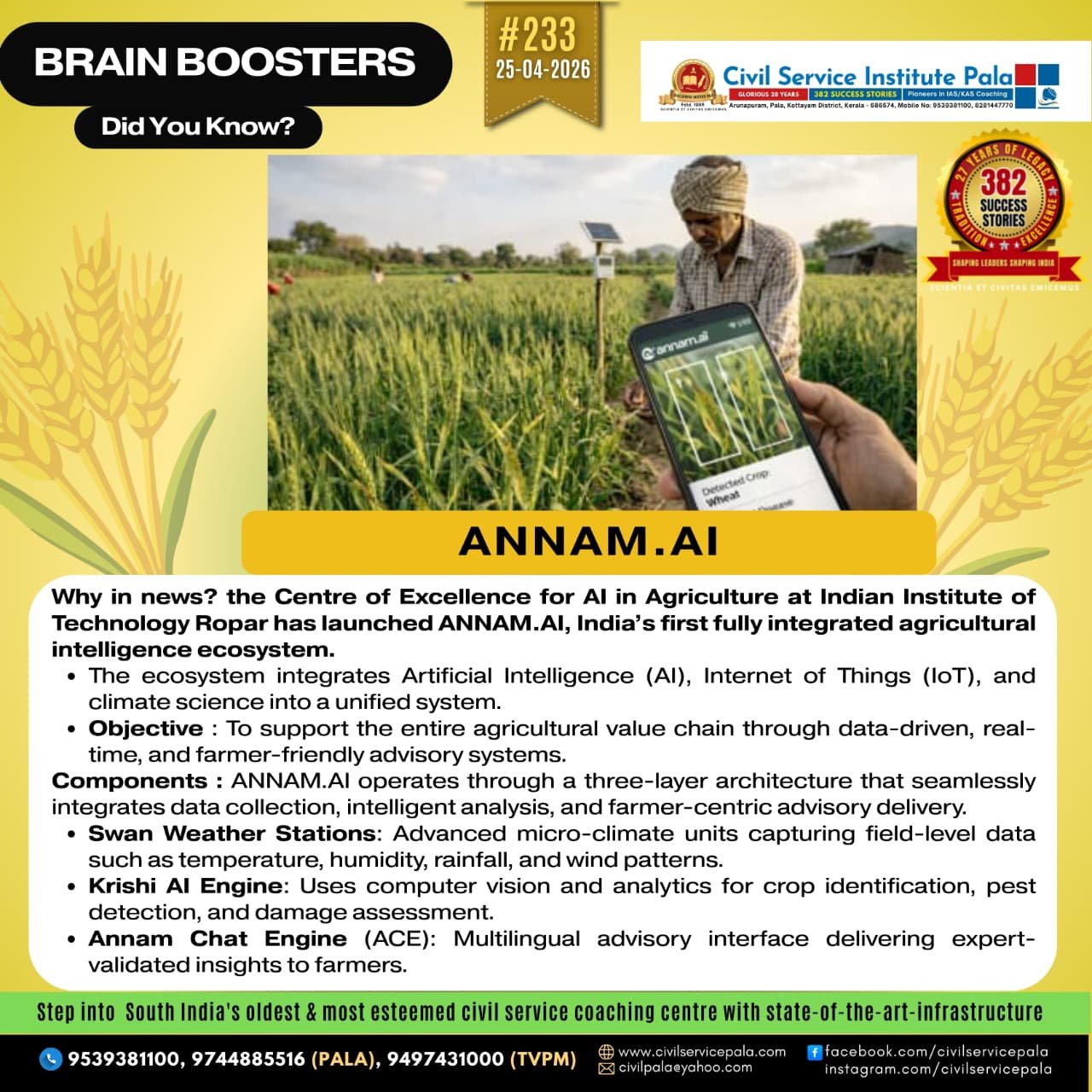
ANNAM.AI
ANNAM.AI
• Indian Institute of Technology Ropar has launched ANNAM.AI, India’s first fully integrated agricultural intelligence ecosystem.
• The initiative reflects India’s broader push towards AI-driven, climate-smart and inclusive agriculture.
Core Objective
• To support the entire agricultural value chain through data-driven, real-time, and farmer-friendly advisory systems.
• To enable precision farming, risk mitigation, and informed decision-making at the field level.
Three-Layer Architecture : ANNAM.AI operates through a three-layer architecture that seamlessly integrates data collection, intelligent analysis, and farmer-centric advisory delivery.
1. Infrastructure Layer
* Includes weather stations and micro-climate intelligence units.
* Enables precise irrigation, pest prediction, and climate risk assessment.
2. Intelligence Layer (Krishi AI)
* Converts raw data into predictive insights using AI and analytics.
* Supports crop diagnostics and forecasting.
3. Engagement Layer (ACE)
* Provides real-time, multilingual advisories on weather, crop planning, pest control, and markets.
* Ensures accessibility even in low-connectivity rural areas.
Key Components
• Swan Weather Stations: Advanced micro-climate units capturing field-level data such as temperature, humidity, rainfall, and wind patterns.
• Krishi AI Engine: Uses computer vision and analytics for crop identification, pest detection, and damage assessment.
• Annam Chat Engine (ACE): Multilingual advisory interface delivering expert-validated insights to farmers.
* At present, the system is operational in pilot regions of Punjab with a phased rollout approach.
Benefits for Farmers : Various tools developed under the ecosystem helps with accurate data models that :
* Reduces water usage by 20–30% through precision irrigation.
* Minimises unnecessary pesticide use via early pest detection.
* Prevents 9–12% crop loss caused by sudden weather events.
* Improves productivity, reduces risks, and enhances income stability.
Significance :
* It marks a shift towards data-driven and climate-resilient agriculture.
* It strengthens digital public infrastructure in farming.
* It promotes inclusive access through multilingual and user-friendly systems.
AI in Indian Agriculture – Indian context
• The India AI Impact Summit 2026 highlighted AI as a tool for inclusive development and governance.
• India promotes the principle of “AI for Humanity”, focusing on equitable access and farmer-centric innovation.AI converts complex data (satellite imagery, weather, soil data) into simple, actionable insights.
• Helps farmers decide what to sow, when to sow, input use, and harvest timing.
• Reduces uncertainty and improves efficiency in farm operations.
Major Applications of intelligence in Agriculture
1. Soil Health Diagnostics
* AI analyses satellite and image data to detect nutrient deficiencies and soil stress.
* Reduces dependence on laboratory testing infrastructure.
2. Climate-Responsive Advisory Systems
* Predicts rainfall patterns, temperature changes, and extreme events.
* Provides real-time guidance on irrigation, pest control, and crop planning.
3. Precision Farming & Mechanisation
* Integrates AI with drones, sensors, and GPS for site-specific input application.
* Enables automated harvesting, weed control, and crop monitoring.
4. Market Intelligence & Price Realisation
* Uses platforms like e-NAM and AGMARKET for predictive analytics.
* Improves price discovery, reduces distress sales, and enhances farmer income.
AI-enabled systems have improved market access and efficiency for millions of farmers. It Enhances productivity while reducing input costs and environmental impact. Furthermore, it also strengthens resilience, especially in rainfed and climate-sensitive regions.
Challenges
* Digital divide and limited access to technology in rural areas.
* Data privacy and governance concerns.
* Need for infrastructure, training, and capacity building.
