



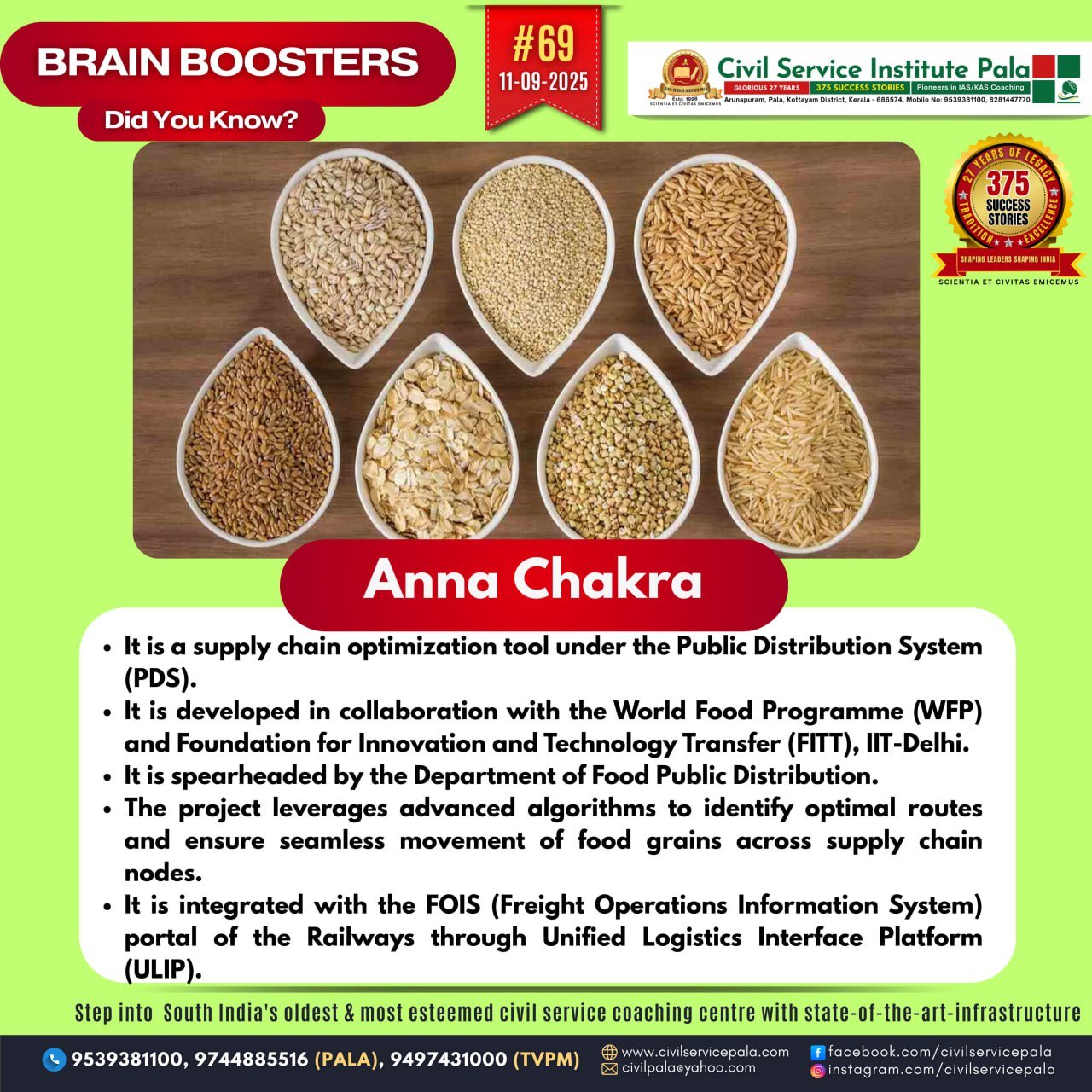
Anna Chakra
Anna Chakra is a supply chain optimisation tool for the Public Distribution System (PDS) in India. It has been launched by the Ministry of Food & Consumer Affairs / Department of Food and Public Distribution.
Alongside Anna Chakra, the government has also rolled out the SCAN portal (“Subsidy Claim Application for NFSA” – National Food Security Act) for streamlining subsidy claims.
What It Aims To Do
Optimise the logistics / routes of transporting food grains (wheat, rice, etc.) under PDS — from the Food Corporation of India (FCI) godowns → state warehouses → fair price shops (FPS).
Reduce costs of transportation, fuel, time etc., thereby saving taxpayer money.
Reduce wastage / leakage in the supply chain by making the movement of food more efficient and trackable.
Environmental benefits: By shortening distances, cutting transport times, optimising routes, it lowers fuel consumption, reducing carbon emissions.
Transparency and speed in subsidy claims (via the SCAN portal):
The portal provides a single window for submission, scrutiny, approval, and settlement of food subsidy claims by states under the NFSA. This is to automate and speed up what had been a more manual and slower process.
Key Features & Technical Details
Developed in partnership with the World Food Programme (WFP) and IIT-Delhi’s Foundation for Innovation & Technology Transfer (FITT). Uses advanced algorithms for route optimisation. One key metric being reduced is QKM (Quantity × Distance in Km) — meaning they look at how many “quintals × distance” the system moves, and try to reduce that. Integration with existing logistics / infrastructure platforms: FOIS (Freight Operations Information System) of Indian Railways via the Unified Logistics Interface Platform (ULIP). PM Gati Shakti platform, which has geo-locations of FPSs and warehouses, helping in mapping and planning.
Scale: It covers ~4.37 lakh Fair Price Shops (FPSs) and ~6,700 warehouses across India. Pilot assessments have been done over 30 states / union territories already.
Expected Impacts / Benefits
Estimated annual savings: ~ ₹250 crore (~ 2.5 billion rupees). These come from reduced transport costs, shorter routes, etc.
Reduction in QKM: A reduction of ~ 58 crore QKM units in the pilot phase. This means less distance × less weight moved unnecessarily.
Distance reduction:
For many supply chains from FCI godowns → state warehouses → FPS, distances have been reduced by 15-50% in pilot states. Faster subsidy claim processing and less lag time for funds transfers etc., via the SCAN portal. This helps states get the subsidies they need more quickly.
Environmental / sustainability benefit:
Less fuel, fewer emissions, better logistical routing. Why It Was Needed / The Rationale The PDS is one of India’s largest food security programmes, covering tens of crores of people. With such scale, small inefficiencies (longer routes, duplication, delays) translate to large cost and time penalties. Earlier, some parts of the route network and supply chain movement had not been optimized for modern logistics or geospatial data. There was potential (as shown by pilots) to reduce unnecessary distance/time. To ensure better accountability, transparency, and reduce leakages / misuse of subsidy money. Also to support the government’s push towards digitization, e-governance in public services. Potential Challenges / Things to Watch While Anna Chakra is promising, some points to watch out for:
Implementation across all states:
Pilots are in 30 states/UTs; actual performance in all regions (including remote / difficult terrain) may vary. Data quality and mapping: The tool relies on accurate geo-locations for warehouses, fair price shops etc., and good data about roads, distances, vehicle capacities. If data is incorrect or outdated, savings may be less. Integration in state systems: PDS is implemented in a decentralized manner. State food departments, local transport infrastructure, coordination between agencies will be key.
Transport infrastructure constraints: Even optimized routes may be impeded by road conditions, seasonal disruptions, capacity of transport vehicles etc. Ensuring actual savings and not just theoretical estimates. Monitoring, audits, feedback loops will be important.
Source: https://www.pib.gov.in/PressReleasePage.aspx?PRID=2081277
