



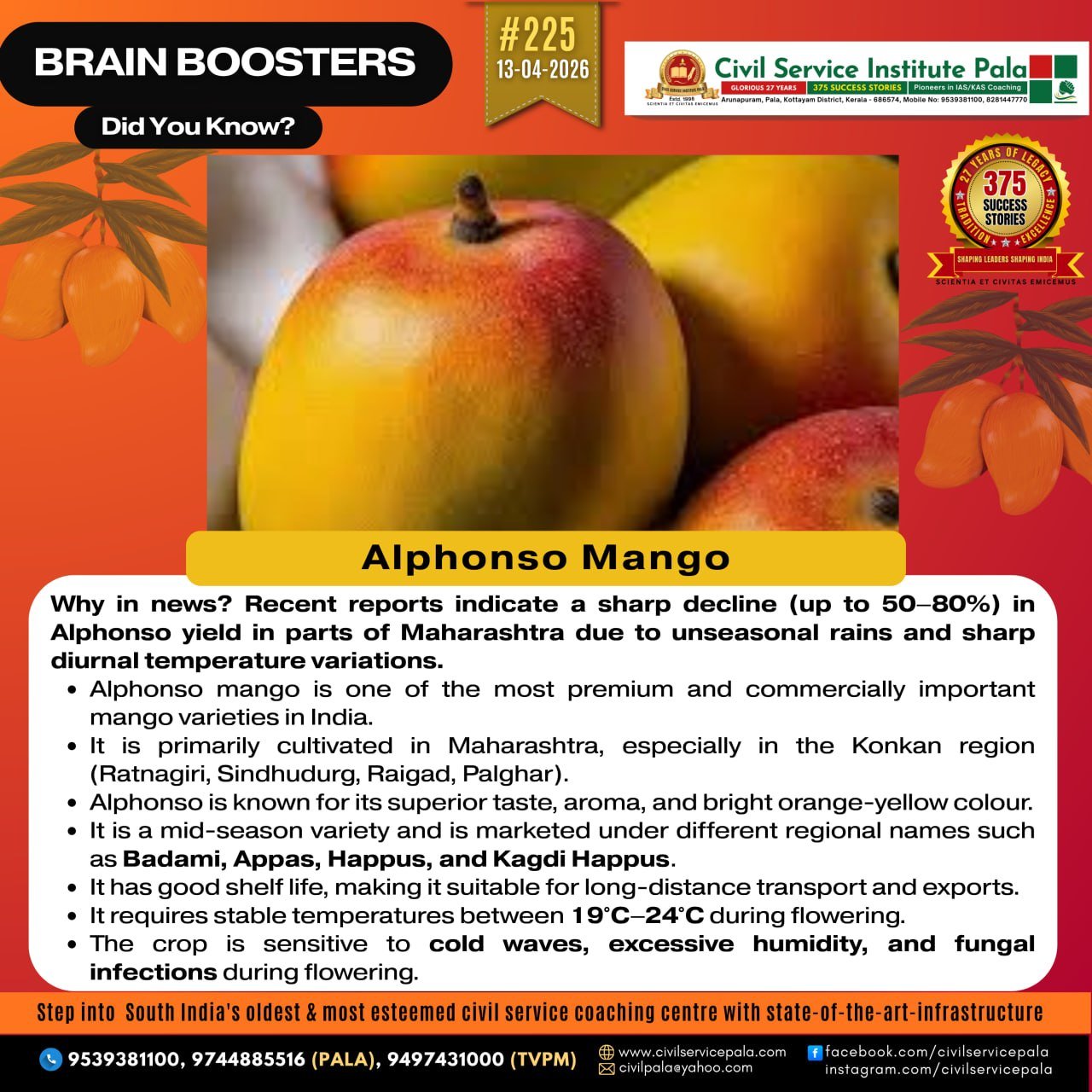
Alphonso Mango
• Alphonso mango is one of the most premium and commercially important mango varieties in India.
• It is primarily cultivated in Maharashtra, especially in the Konkan region (Ratnagiri, Sindhudurg, Raigad, Palghar).
• Alphonso is known for its superior taste, aroma, and bright orange-yellow colour.
• It is a mid-season variety and is marketed under different regional names such as Badami, Appas, Happus, and Kagdi Happus.
• It has good shelf life, making it suitable for long-distance transport and exports.
• It requires stable temperatures between 19°C–24°C during flowering.
• The crop is sensitive to cold waves, excessive humidity, and fungal infections during flowering.
• Hybrid varieties involving Alphonso include Arka Aruna, Arka Puneet, Ratna, and Sindhu.
Economic and Social Impact
• Farmers reported drastic reduction in output in the current season.
• Labour demand declined, leading to loss of seasonal employment.
• High cultivation costs combined with low yield reduced profitability.
• that delayed crop insurance payments worsen their financial stress.
Challenges
• Climate variability is the biggest threat to Alphonso cultivation.
• Dependence on specific temperature conditions makes the crop highly vulnerable.
• Pest and fungal attacks increase under high humidity and dew conditions.
• Market fluctuations and supply shocks impact both farmers and consumers.
• Lack of timely crop insurance settlement reduces resilience of farmers.
India continues to hold its place as the world’s largest producer of mangoes, contributing nearly 40–45 percent of global mango production, according to the Ministry of Agriculture and Farmers Welfare. In the crop year 2024-25 (second advance estimates), India produced 228.37 lakh tonnes of mango, reaffirming the fruit’s central role in the country’s horticulture sector.
The Mission for Integrated Development of Horticulture (MIDH) is at the core of this effort, supporting farmers across all states and Union Territories. The programme provides assistance for quality planting material, area expansion, post-harvest management, primary processing, and creation of marketing infrastructure. Schemes like Rashtriya Krishi Vikas Yojna (RKVY), Pradhan Mantri Fasal Bima Yojna, Agriculture Infrastructure Fund (AIF), and initiatives by the National Horticulture Board (NHB) and APEDA also contribute to mango sector development, including packhouses and export promotion.
Indian Council of Agricultural Research (ICAR), which operates key mango research institutions such as the Central Institute of Subtropical Horticulture (Lucknow), Indian Institute of Horticultural Research (Bengaluru), and Indian Agricultural Research Institute (New Delhi). Currently, 23 All India Coordinated Research Project (AICRP) centres are dedicated to mango. These institutions, along with State Agricultural Universities, are engaged in developing new varieties, improving cultivation practices, and advancing post-harvest technologies.
to protect mango growers from distress sales, the government implements the Market Intervention Scheme (MIS) under the Pradhan Mantri Annadata Aay Sanrakshan Abhiyan (PM-AASHA). This provides a mechanism to ensure remunerative prices when there is a sharp fall in market demand or prices of perishable horticulture produce like mango.
With India’s mango sector accounting for nearly half of the world’s production, the government’s focus remains on enhancing productivity, value addition, and exports through existing horticulture missions rather than creating a new board or expanding MSP coverage.
Mango Cultivation in India
• India continues to be the world’s largest producer of mango, contributing nearly 40–45% of global production and reaffirming its dominance in the horticulture sector.
• In the crop year 2024–25 (second advance estimates), India produced about 228.37 lakh tonnes of mango, highlighting the crop’s economic and agricultural significance.
• The Mission for Integrated Development of Horticulture (MIDH) plays a central role in supporting mango cultivation by providing assistance for planting material, area expansion, post-harvest management, and marketing infrastructure.
• Government initiatives such as Rashtriya Krishi Vikas Yojana (RKVY), Pradhan Mantri Fasal Bima Yojana (PMFBY), and Agriculture Infrastructure Fund (AIF) complement horticulture development by improving risk coverage, infrastructure, and investment support.
• Institutions like the Indian Council of Agricultural Research (ICAR) and its specialised centres are actively engaged in developing improved mango varieties, enhancing cultivation practices, and advancing post-harvest technologies.
• A network of 23 All India Coordinated Research Project (AICRP) centres, along with State Agricultural Universities, contributes to scientific research and innovation in mango production.
• Export promotion and value addition are supported by agencies such as Agricultural and Processed Food Products Export Development Authority (APEDA) and the National Horticulture Board through initiatives like packhouses and cold-chain infrastructure.
• The government implements the Market Intervention Scheme (MIS) under Pradhan Mantri Annadata Aay Sanrakshan Abhiyan (PM-AASHA) to protect mango growers from distress sales during periods of price fall or excess supply.
