



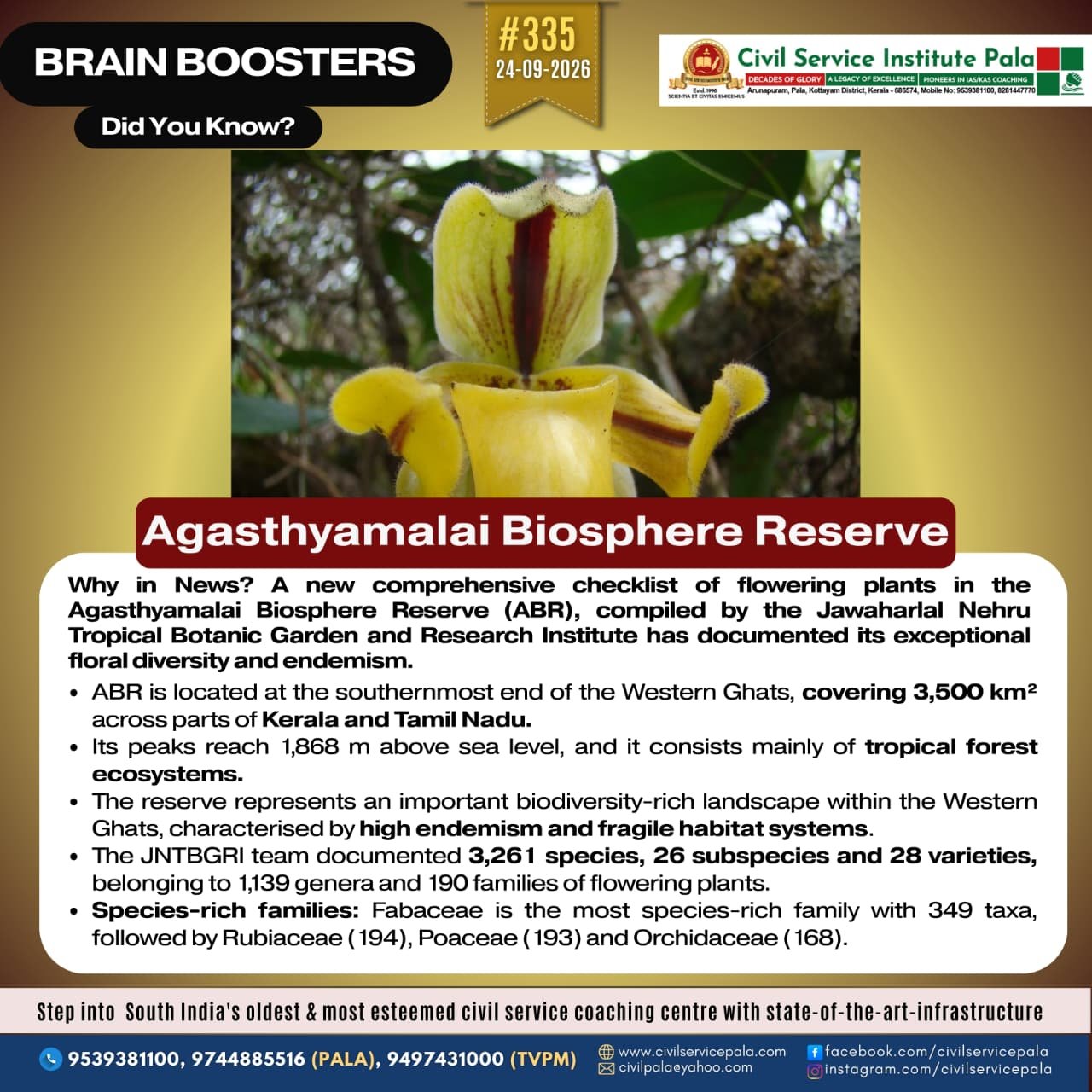
Agasthyamalai Biosphere Reserve: Floral Diversity and Endemism
Agasthyamalai Biosphere Reserve: Floral Diversity and Endemism
Why in News?
A new comprehensive checklist of flowering plants in the Agasthyamalai Biosphere Reserve (ABR), compiled by the Jawaharlal Nehru Tropical Botanic Garden and Research Institute (JNTBGRI), Thiruvananthapuram, has documented its exceptional floral diversity and endemism.
Agasthyamalai Biosphere Reserve (ABR)
Biodiversity-rich landscape: ABR is located at the southernmost end of the Western Ghats, covering 3,500 km² across parts of Kerala and Tamil Nadu. Its peaks reach 1,868 m above sea level, and it consists mainly of tropical forest ecosystems.
Biogeographical significance: The reserve represents an important biodiversity-rich landscape within the Western Ghats, characterised by high species richness, endemism and fragile habitat systems.
Ecological and Biological Profile of ABR
Plant diversity: ABR contains 2,254 species of higher plants, including about 405 endemics, and serves as a genetic reservoir of cultivated plants such as cardamom, jamun, nutmeg, pepper and plantain.
Faunal diversity: The reserve has about 79 mammal species, 88 reptile species, 45 amphibian species and 46 fish species. Among these, 20 mammals, 45 reptiles, 30 amphibians and 10 fish species are endemic. A total of 337 bird species have also been reported, including 20 endemics.
Protected areas within ABR: The reserve includes Shendurney, Peppara and Neyyar Wildlife Sanctuaries, as well as the Kalakad Mundanthurai Tiger Reserve.
Local communities: Several tribal settlements are located within the reserve and depend largely on biological resources for sustenance. Recent projects have been established to reduce dependence on forests.
Key Findings of the New Checklist
Extensive floral diversity: The JNTBGRI team documented 3,261 species, 26 subspecies and 28 varieties, belonging to 1,139 genera and 190 families of flowering plants.
Species-rich families: Fabaceae is the most species-rich family with 349 taxa, followed by Rubiaceae (194), Poaceae (193) and Orchidaceae (168).
High endemism: 1,018 taxa (31.2%) are endemic to India, including 245 steno-endemic taxa that are confined to highly specialised habitats. This highlights ABR as both a refugium of ancient lineages and an active centre of speciation.
Sri Lankan affinity: The flora shows strong biogeographic affinity with Sri Lanka, with 347 shared taxa. Possible explanations include historical land connections during periods of lower sea levels, shared Gondwanan history and long-term climatic similarities.
Tropical American affinity: 102 taxa show affinity with tropical American flora. Possible explanations include long-distance dispersal, pan-tropical distribution patterns or naturalisation following human introduction.
Why was a New Checklist Needed?
Taxonomic inconsistencies: ABR has been documented through historical floras, regional accounts, unpublished reports and evolving taxonomic databases. These sources sometimes differ in nomenclature, taxonomic interpretation and distributional records, creating inconsistencies and potential misidentifications.
Integrated taxonomic review: The new checklist evaluated classical floras, original and recent literature, and global taxonomic repositories to consolidate the available information.
Conservation Concerns
Multiple anthropogenic pressures: Habitat fragmentation, climate change, biological invasion and ecological degradation threaten habitat-specific and narrowly distributed species in ABR.
Region-specific conservation: The researchers recommend ecological restoration, ex situ conservation, long-term surveillance and community-based initiatives tailored to the region.
Future research: Combining classical taxonomy with molecular phylogenetics, phylogenomics, population genetics and ecological niche modelling can improve understanding of the evolutionary history, diversification patterns and climate vulnerability of endemic lineages.
