



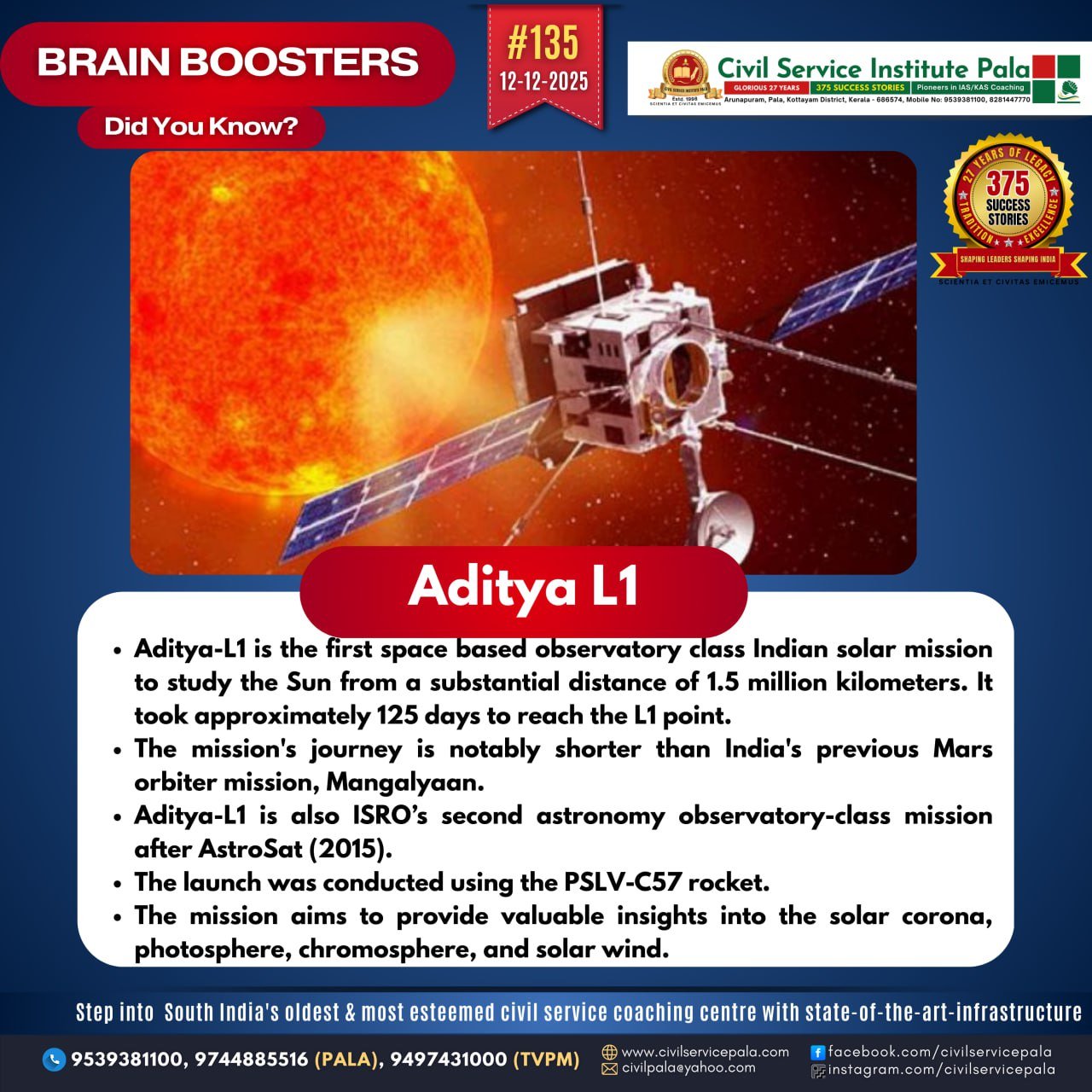
Aditya-L1
Aditya-L1 is India’s first dedicated solar observatory mission, launched by ISRO on 2 September 2023. The spacecraft is designed to study the Sun, especially the outer atmosphere, from a unique vantage point called the L1 Lagrange Point — located about 1.5 million km from Earth. At this location, the gravitational forces of the Sun and Earth balance out, allowing the spacecraft to stay in a stable position with minimal fuel use and obtain uninterrupted views of the Sun.
Key Objectives
Study the solar corona – temperature, composition, and heating mechanisms.
Observe solar wind and understand how it affects space weather.
Investigate solar flares and coronal mass ejections (CMEs) that can impact satellites, GPS, and power grids on Earth.
Understand the connection between Sun’s magnetic fields, corona, and solar activity cycles.
Provide advance warnings of solar storms, boosting India’s space weather forecasting capability.
Why L1 Point?
Continuous, never-blocked view of the Sun.
Accurate and early detection of solar storms before they reach Earth.
Ideal location for monitoring space weather.
Payloads on Aditya-L1
The spacecraft carries seven scientific instruments, including:
Remote-sensing instruments
VELC (Visible Emission Line Coronagraph) – studies the corona and CMEs.
SUIT (Solar Ultraviolet Imaging Telescope) – images the Sun’s photosphere & chromosphere.
SoLEXS (Soft X-ray Spectrometer) – detects solar flares.
HEL1OS (High Energy L1 Orbiting X-ray Spectrometer) – studies high-energy events.
In-situ instruments
ASPEX (Aditya Solar wind Particle Experiment) – observes solar wind particles.
PAPA (Plasma Analyser Package for Aditya) – monitors solar plasma behaviour.
MAG (Tri-axial Magnetometer) – measures magnetic field variations at L1.
Achievements & Significance
India became the first country to place a solar observatory at L1 on its first attempt.
Important for protecting:
communication satellites
navigation systems
power infrastructure
Enhances India’s position in heliophysics research.
In early 2024, the spacecraft successfully entered its halo orbit around L1, and the instruments started returning valuable data on solar flares, plasma behaviour, and coronal dynamics.
