



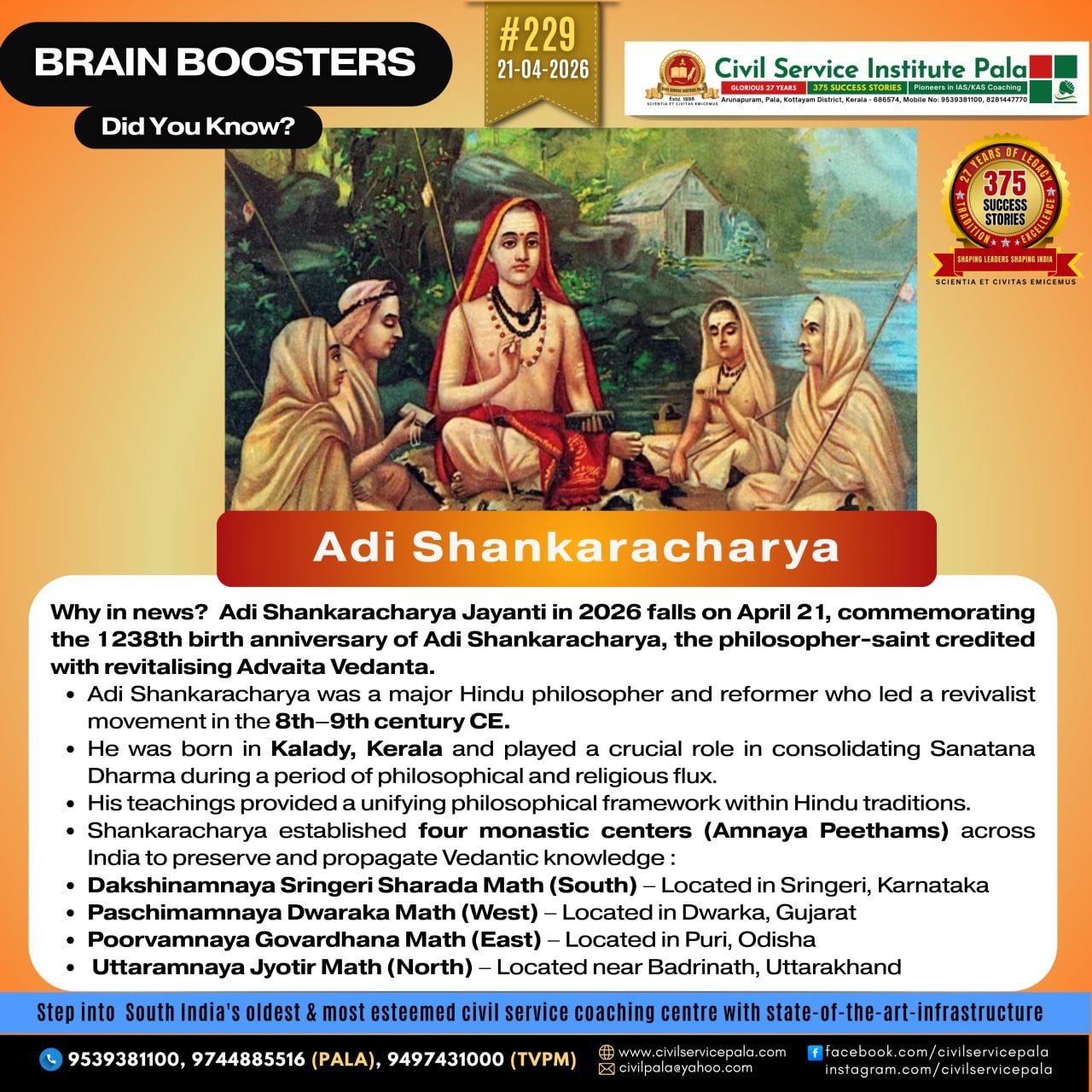
Adi Shankaracharya
Adi Shankaracharya was a major Hindu philosopher and reformer who led a revivalist movement in the 8th–9th century CE.
• He was born in Kalady and played a crucial role in consolidating Sanatana Dharma during a period of philosophical and religious flux.
• His teachings provided a unifying philosophical framework to counter fragmentation within Hindu traditions.
Philosophy of Advaita Vedanta
• Shankaracharya propounded the doctrine of Advaita Vedanta, which asserts that Brahman alone is the ultimate reality.
• He explained that the world appears real due to Maya, but in essence it is not separate from Brahman.
• He argued that the individual soul (jiva) is identical with Brahman, and the perception of difference arises due to ignorance (Avidya).
• Liberation (Moksha) is achieved through realization of this non-dual identity, as stated in the Mahavakyas of the Upanishads.
• He accepted Karma and Bhakti as preparatory paths, which purify the mind and enable attainment of knowledge (Jnana).
Conceptual Contributions
• Shankaracharya emphasized the distinction between:
o Paramarthika reality (absolute truth: Brahman alone exists).
o Vyavaharika reality (practical world: necessary for daily life and spiritual practice).
• His philosophy was highly abstract, which limited its accessibility to the masses.
Institutional Contributions – Four Maths
• Shankaracharya established four monastic centers (Amnaya Peethams) across India to preserve and propagate Vedantic knowledge.
• These Maths ensured geographical spread and institutional continuity of Advaita philosophy.
Four Major Maths:
• Dakshinamnaya Sringeri Sharada Math (South) – Located in Sringeri, Karnataka
• Paschimamnaya Dwaraka Math (West) – Located in Dwarka, Gujarat
• Poorvamnaya Govardhana Math (East) – Located in Puri, Odisha
• Uttaramnaya Jyotir Math (North) – Located near Badrinath, Uttarakhand
• Experts highlight that these institutions function as centres of scriptural learning, spiritual training, and preservation of dharmic traditions even today.
Key Disciples
• Shankaracharya’s teachings were systematised and spread by four principal disciples:
o Sureshwara
o Padmapada
o Totaka
o Hastamalaka
• These disciples were appointed as heads of the four Maths, ensuring continuity of tradition.
Legacy and Significance
• Shankaracharya integrated diverse religious practices into a coherent philosophical system based on non-dualism.
• He strengthened the intellectual foundations of Hinduism and revived Vedic authority.
• His institutional framework ensured the long-term survival and spread of Advaita Vedanta across India.
• His teachings continue to shape Indian philosophy, spirituality, and cultural identity.
