



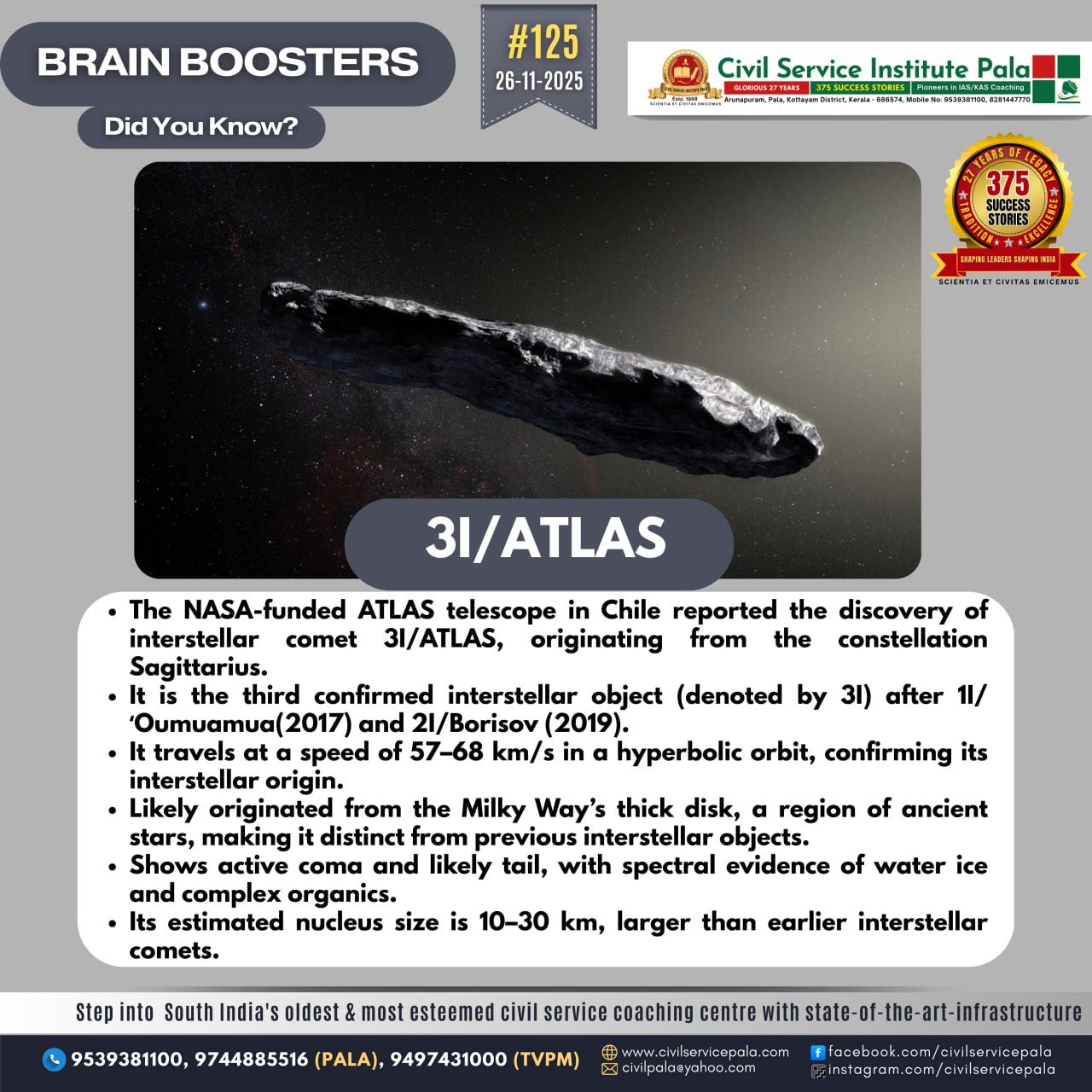
3I/ATLAS
What is 3I/ATLAS
3I/ATLAS is an interstellar comet — that means it did not form in our Solar System, but likely originated around another star.
It was first detected in July 2025 by the survey telescope program ATLAS (Asteroid Terrestrial-impact Last Alert System).
The “3I” in its name stands for “third interstellar” — it is the third confirmed interstellar object humanity has observed.
Orbital Path, Speed, and Fate
3I/ATLAS travels on a hyperbolic orbit, meaning it’s not bound to the Sun. It’s just passing through and will eventually leave the Solar System — never to return.
Its speed is extremely high — among the fastest known objects to enter our Solar System.
It will (or did) pass by the Sun and then continue outward, giving astronomers a rare, one-time opportunity to observe material from another star system.
What Makes 3I/ATLAS Strange / Interesting
Several findings from telescopes — including space telescopes — indicate 3I/ATLAS behaves differently from typical comets in our Solar System:
As it neared the Sun, 3I/ATLAS developed a coma (a cloud of gas and dust) and a tail/dust stream, as expected for comets. However, the composition of that coma is unusual. Observations found carbon dioxide as a dominant gas — perhaps more so than water, which is rare.
National Geographic
Astronomers also detected metals like nickel (and hints of iron) being ejected — jettisoned by the comet — in conditions where typical cometary outgassing wouldn’t explain them.
Some spectroscopic analyses reportedly indicate the presence of nickel tetracarbonyl, a metal-carbon compound never before observed naturally in space.
Because of such anomalies — the odd chemical composition, unexpected metal emissions far from the Sun, and the unusual orbit — some scientists find 3I/ATLAS much stranger than a “regular” comet.
Speculations — Why Some Suggest “Not Just a Comet”
Because 3I/ATLAS is so different, it has sparked some bold speculation:
A small number of scientists — including Avi Loeb — have proposed that 3I/ATLAS might not be a natural comet at all. Instead, it could be an artificial object or probe, possibly of extraterrestrial origin.
The arguments for this are based on some of the comet’s oddities: unusual trajectory, emissions not normally seen in comets, and non-standard behavior that doesn't easily fit into established models.
That said — and this is important — most astronomers are very cautious about such claims. The mainstream consensus remains that 3I/ATLAS is a natural interstellar comet, albeit a very odd one.
Why 3I/ATLAS Matters: What We Can Learn
Because it comes from outside our Solar System, 3I/ATLAS might carry chemical signatures of its place of origin — giving us rare, direct clues about the composition of planetary systems around other stars.
Studying it may help scientists compare interstellar objects to comets from our own system — shedding light on how unique (or typical) our Solar System’s chemistry really is.
Its weird behavior (if validated) might expand our understanding of what kinds of objects exist in the galaxy beyond the "standard" comets, asteroids, and planets.
